
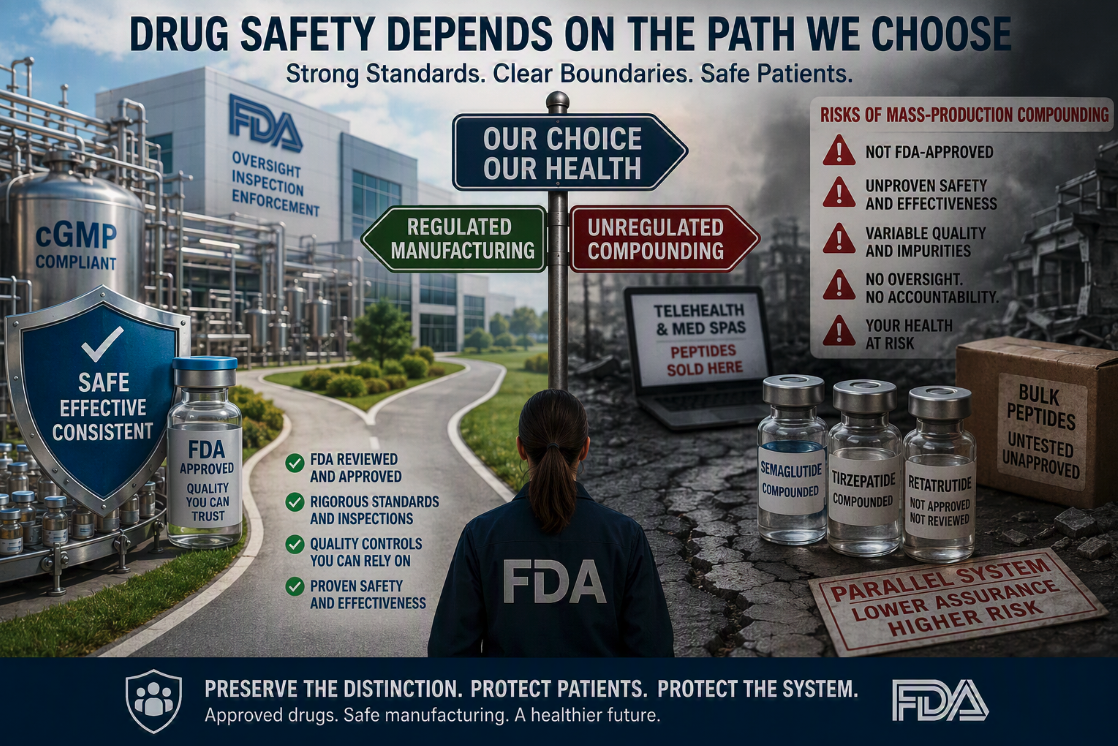
A Larger Context for Readers Monitoring FDA’s Review of Unapproved Peptide Drugs
For more than a century, FDA has been working towards ensuring that drugs are consistently manufactured at scale to FDA standards. As a result, consumers can be largely assured of drugs that are safe, effective, and identical to the FDA-approved original, generic, or biosimilar product.
My most recent column on the topic (here) compared the situation to a large jigsaw puzzle with a few pieces missing, yet the picture and its meaning are crystal clear.
Unfortunately, there are significant barriers to getting those last few pieces in place. For the most part, we know what needs to be done, but we may lack the public support and political will to make that happen.
The Challenge
FDA oversight of drug manufacturing is necessary because prescribers and patients lack the time, energy, equipment, and skills to independently assess manufacturing quality. No drug is safe or effective if it is not manufactured precisely to an approved standard. Even a little leeway risks substantial degradation.
Institutionalizing broad exceptions to the FDA rules would send us backward in time. From the mid-1850s until the early 1900s, a period known as the patent medicine age, consumers had no assurance of manufacturing quality or of a drug’s safety and effectiveness. Caveat emptor (buyer beware) ruled the day.
Long-Term Threats to FDA’s Framework for Safe Drug Manufacturing
Drug manufacturing standards–primarily the Current Good Manufacturing Practices (cGMP)–are the backbone of FDA oversight and have proven effective over many years. Thus, the long-term threat to FDA regulation of manufacturing is not the rules, but the steady erosion of their practical effect in a dramatically changing marketplace.
The result is a widening gap between a robust regulatory framework for drug manufacturing and distribution (including ingredient sourcing), and the operational realities of a globalized, profit-driven supply chain. Notably, global price competition does not reward or reinforce manufacturing excellence.
The FDA’s newest initiative, the Quality Management Maturity Program (QMM), is an important add-on to the agency’s efforts. As an incentive for quality, it links demonstrated quality performance to tangible regulatory benefits, including inspection frequency and engagement priority.
As I noted in Part 1 (here), safe drug manufacturing is vital but not glamorous. Stable, adequate funding for inspection and enforcement, particularly in high-risk global supply chains, is essential.
Short-Term Threats: The Growing Normalization of Mass-Production Compounding
Under US law, compounding occupies a necessary but narrow role in the production of drugs. Compounding is meant to address patient-specific needs that cannot be met by standard formulations available in commercially available products and in drug shortages declared by FDA.
It was never intended for compounders to become manufacturers of 1/ commercially available products, 2/ drug products in development, or 3/ unapproved drug products that have not demonstrated safety and efficacy through FDA’s legally-mandated review process.
The risk–a substantial one–is the creation of a parallel system operating outside FDA’s core manufacturing and product safeguards. The most immediate threat is the normalization of mass-production compounding.
Compounded versions of semaglutide and tirzepatide (FDA-approved GLP-1 treatments for diabetes, obesity, and other conditions) are widely available through telehealth sites and med spas. This is despite FDA’s repeated public warnings that the compounded products are 1/ not FDA-approved, and, 2/ because they are commercially available, should only be compounded to meet a specific individual’s needs.
More recently, retatrutide–a potent weight loss product in clinical trials–has become available in the telehealth marketplace. FDA has not yet reviewed (or approved) the product or its intended use, formulation, or dose. (More here)
Additionally, on July 22 and 23, an FDA advisory committee will consider whether seven peptide drugs can be added to the “safe to compound” list. None of the seven are FDA reviewed or approved; none are in advanced clinical trials; none are supported by scientific and medical consensus on safety and efficacy; none have a USP monograph (here) to guide the formulation of the final product as other compounded ingredients do. (For a deeper dive on peptide compounding, I recommend The Five Risks of Taking Untested Peptides.)
While each of these situations needs specific attention, a central question is which drugs, if any, are safe and appropriate for compounding. Increasingly, the compounding process is seen as a pathway to bypass the FDA safe drug manufacturing regulations and its inspection and enforcement authority. With the latest focus on peptides, FDA’s authority to review and approve drugs is also at risk.
All of these compounding situations involve serious safety concerns. For the most part, these are complex peptides and other advanced therapeutics. Among other things, they require tightly controlled, multi-step processes; rigorous impurity profiling; and validated stability data.
When produced within FDA’s regulatory framework, these controls are integral and enforceable. In compounding environments, they may be adequate or lax, partial or absent.
In each of these situations, compounding also introduces a systemic economic distortion. If unapproved alternatives can compete directly without bearing the same regulatory costs, the long-term effect will be to erode the regulatory system itself.
FDA should establish explicit limits on high-risk compounding categories, clarify the distinction between compounding and manufacturing, and increase enforcement against large-scale, non-patient-specific operations. Increased oversight of “active pharmaceutical ingredient” (API) supply chains is also needed—particularly for imported or poorly characterized materials.
Conclusion
FDA’s manufacturing framework remains one of the most consequential public health systems in the world.
- Its long-term viability depends on maintaining both rigor and clarity in the face of evolving pressures.
- The expansion of loosely regulated mass compounding poses a direct and immediate challenge to the system’s integrity.
FDA risks being outpaced by the system it regulates. The path forward should not be incremental accommodation, but disciplined boundary-setting. We need to strengthen quality within regulated manufacturing while preventing the emergence of a parallel, lower-assurance pathway.
In this context, preserving the distinction between approved and unapproved production is not a technical detail—it is the foundation of drug safety itself.


